
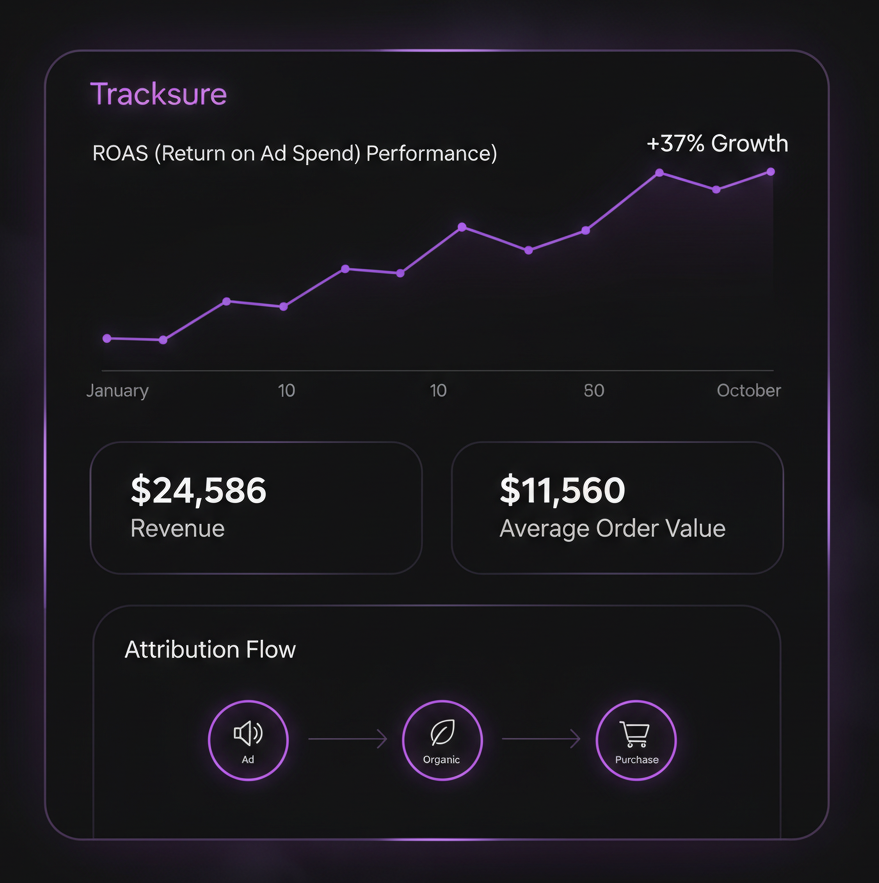
Meta Ads Update 2026: Why Reported Conversions Dropped — and Why This Is a Big Opportunity for TrackSure
Meta’s latest attribution update changes what gets counted as a click-through conversion. That may make Ads Manager look worse at first — but it also creates a major opportunity for brands that want cleaner first-party analytics, better customer journey visibility, and more reliable server-side tracking.
What’s inside this guide
Quick summary
The headline: Meta is changing click-through attribution for website and in-store conversions so that it only includes link clicks. Social interactions like likes, shares, and saves are being shifted into engage-through attribution. Meta also reduced the engaged-view threshold for video ads from 10 seconds to 5 seconds.
- Your sales may not have dropped even if Ads Manager shows fewer click-through conversions.
- This update can create cleaner alignment with Google Analytics, but it does not solve the full customer journey problem.
- Brands now need a more independent source of truth using first-party analytics and server-side tracking.
- That is exactly where TrackSure becomes more valuable.
What changed in the Meta Ads update
Meta announced a new measurement framework for a more social-first world. The biggest practical change is simple: for website and in-store conversions, click-through attribution will now only include link clicks. This matters because older reporting often mixed link clicks with other social interactions, which made Meta Ads Manager look different from third-party tools.
At the same time, Meta says actions such as likes, shares, saves, and other non-link social interactions are being moved into engage-through attribution, a renamed version of what was previously called engaged-view attribution. Meta also updated video measurement by reducing the engaged-view threshold from 10 seconds to 5 seconds. These changes are intended to simplify reporting and improve alignment with outside tools, while still showing the value of social engagement. Read Meta’s official announcement.
Industry coverage also notes that Meta is partnering with analytics providers like Northbeam and Triple Whale to help advertisers evaluate both clicks and views more holistically. Search Engine Land covered the update here.
Why your reported conversions may look lower now
Many advertisers will log into Meta Ads Manager after this rollout and think their campaigns suddenly stopped working. In a lot of cases, that will be the wrong conclusion.
What changed is not necessarily demand. What changed is how Meta categorizes attribution.
| Before | After the Meta Ads update 2026 | What it means |
|---|---|---|
| Click-through attribution could include multiple interaction types | Click-through attribution focuses on link clicks only | Reported click-through conversions may decrease |
| Likes, shares, and saves could feel mixed into reporting | These shift into engage-through attribution | Social influence becomes more separated from website click behavior |
| Video engaged-view threshold was 10 seconds | Video engaged-view threshold becomes 5 seconds | Meta is adapting to faster social conversion behavior |
That means a campaign can still be profitable while its reported click-through conversion count looks lower. This is exactly why advertisers need better attribution context instead of relying on one platform dashboard alone.
Why Meta Ads and Google Analytics still won’t tell the same story
Even with this change, Meta Ads and Google Analytics are not designed to measure the exact same behavior in the exact same way. Meta wants to show the impact of social interactions and impression-driven influence. Google Analytics focuses much more on what happened on your website.
That is why many businesses compare:
- Meta Ads Manager
- Google Analytics
- WooCommerce or Stripe revenue
…and end up with three different numbers.
This update may reduce one type of mismatch, but it does not solve the bigger measurement problem: the customer journey is still multi-touch, delayed, and messy.
Example: A visitor sees your ad, does not click, comes back later through search or email, and then buys. Standard platform reporting may not capture that story clearly enough for you to make confident budget decisions.
Why this is a major opportunity for TrackSure
The best TrackSure angle is not “Meta is broken.” The better message is:
Meta made reporting stricter. Now brands need their own source of truth.
That message works because it aligns with the actual market direction. The more ad platforms tighten definitions, shorten attribution windows, and evolve reporting models, the more valuable first-party analytics, server-side tracking, and customer journey visibility become.
- TrackSure runs inside WordPress, so your data stays on your server.
- TrackSure includes analytics, journeys, funnels, and attribution, not just event forwarding.
- TrackSure supports Meta CAPI and GA4 server-side delivery, which helps recover conversions your browser pixel misses.
How TrackSure fits the new measurement reality
On the TrackSure website, the product is positioned around privacy-friendly first-party analytics, visitor journeys, funnels, attribution, and server-side tracking inside WordPress. That is a strong match for the problem advertisers are now feeling more directly.
What advertisers should do next
- Do not panic if reported click-through conversions drop. Look for whether sales, revenue, or qualified leads also dropped.
- Separate reporting changes from actual performance changes. A stricter attribution definition can reduce reported conversions without reducing real outcomes.
- Review your customer journey data. See what happens between ad exposure, site visit, return visit, and final conversion.
- Strengthen first-party measurement. That includes analytics you control, not just dashboards you rent.
- Use server-side tracking where it makes sense. Browser-only tracking is under pressure from privacy changes, ad blockers, and cookie restrictions.
The practical takeaway: Meta’s update is not bad news for smart advertisers. It is a reminder that the future belongs to brands that own more of their measurement stack.
Internal resources you can explore next
TrackSure Features
Learn how TrackSure handles analytics dashboards, visitor journeys, funnels, attribution, and server-side event delivery inside WordPress.
TrackSure Pricing
Compare the free and premium plans, including Meta CAPI, GA4, attribution features, and power-user upgrades.
TrackSure Support
Use this page if you want help with setup, attribution questions, technical support, or pre-sales questions.
TrackSure Blog
Publish more supporting articles around attribution, Meta CAPI, first-party analytics, and privacy-safe measurement.
External references
Frequently Asked Questions
What is the Meta Ads update 2026 in simple terms?
Meta changed how it counts click-through attribution for website and in-store conversions. Instead of grouping several interactions together, it now focuses click-through attribution on link clicks only. Non-link interactions like likes, saves, and shares move into engage-through attribution.
Why are my Meta Ads showing fewer conversions now?
Your campaign may not actually be performing worse. Meta may simply be reporting fewer click-through conversions because it now uses a stricter definition. In other words, your reporting can drop even when your sales do not.
Will Meta Ads and Google Analytics finally match perfectly?
No. This update can reduce one source of mismatch, but Meta and Google Analytics still measure different parts of the customer journey. Impression influence, return visits, and multi-touch paths still create reporting differences.
What is engage-through attribution?
Engage-through attribution is the updated category Meta is using for conversions influenced by non-link social interactions, such as likes, shares, saves, and other engagement behavior that is not a direct website link click.
Why does this matter for WordPress site owners?
Because many WordPress businesses rely heavily on Meta Ads, Google Analytics, and platform dashboards. When those numbers shift, it becomes more important to own more of your analytics and attribution stack using first-party tools.
How does TrackSure help after the Meta attribution changes?
TrackSure helps by combining first-party analytics, visitor journeys, funnels, and server-side tracking inside WordPress. That gives you a better view of what actually happened on your site, not just what one ad platform chose to report.
Is TrackSure only for advertisers?
No. TrackSure is also useful for site owners who want simpler privacy-friendly analytics inside WordPress without relying entirely on Google Analytics.
Final takeaway
Meta’s update is a signal, not a setback. The market is moving toward stricter attribution definitions, more privacy pressure, and greater demand for first-party visibility. Brands that build their own measurement confidence now will make better decisions later.
That is the opportunity for TrackSure: help WordPress site owners stop guessing, own more of their data, and understand the real customer journey with less noise.